Free download · No sign-up
Business Model Canvas template
A clean, printable canvas with guiding questions in every block. Grab the PDF for printing or the PNG for slides and whiteboards — free, no email wall.
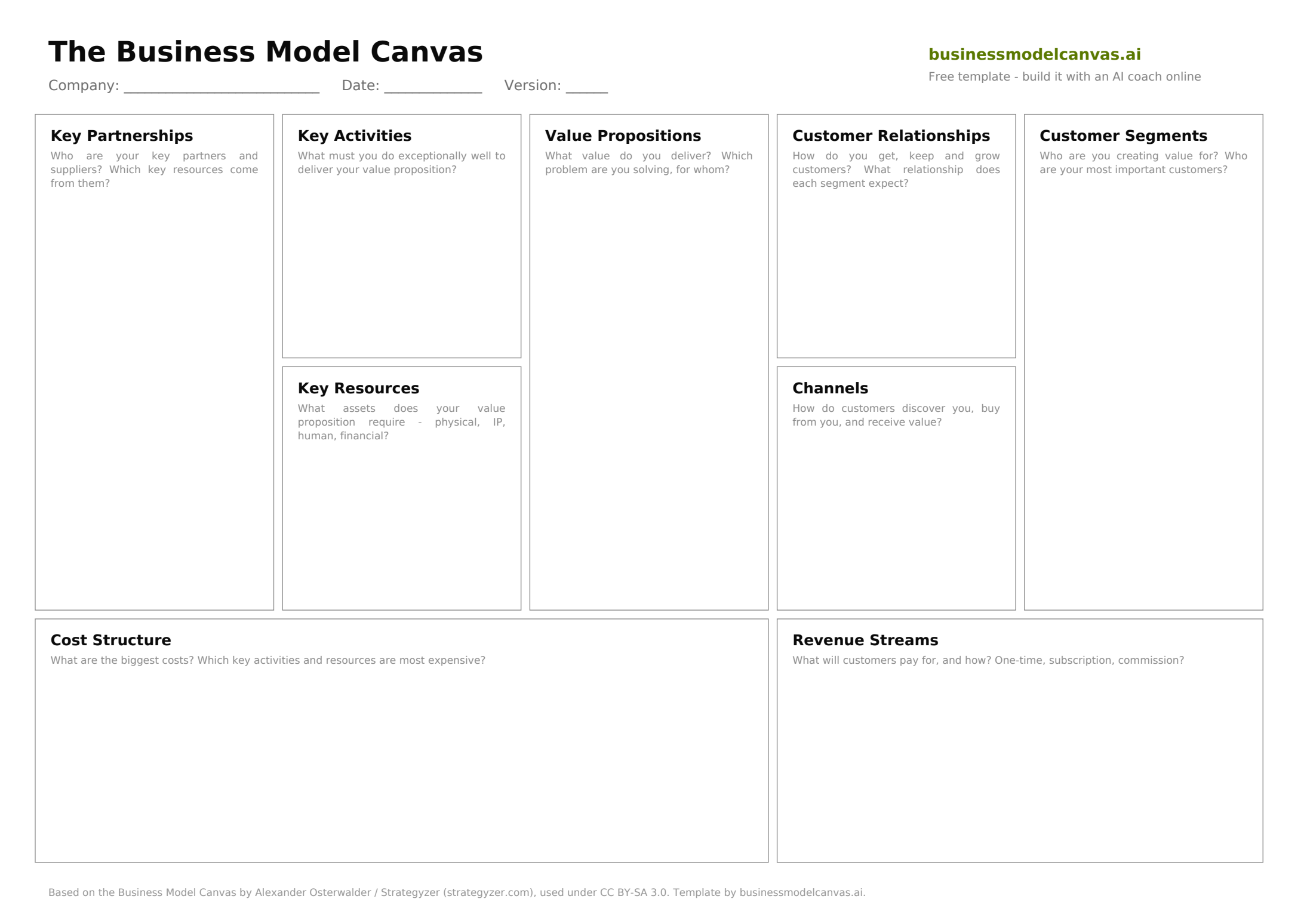
A4 landscape · print-ready · attribution included (CC BY-SA 3.0)
How to fill out the template
- Customer Segments first. Everything else depends on who you serve — be narrower than feels comfortable.
- Value Propositions. The specific problem you solve for that segment, stated in their words.
- Channels & Relationships. How they find you, buy from you, and why they stay.
- Revenue Streams. What they’ll actually pay for, and how — before you build it.
- The left side. Resources, activities and partners needed to deliver — then total it in Cost Structure.
- Mark your assumptions. Circle the claims you haven’t verified. Those are the canvas’s real output.
Want worked examples first? See how Netflix, Airbnb and Uber fill all nine blocks in our examples library.
Prefer not to stare at empty boxes?
The online version fills itself as you answer questions: an AI coach guides every block, auto-detects your risky assumptions, and exports a finished canvas as PDF. Free to start.
Template FAQ
Is this business model canvas template really free?
Yes — download the PDF or PNG with no sign-up, no email, no watermark beyond a small credit line. Use it for startups, classrooms, or client work.
What are the 9 building blocks of the Business Model Canvas?
Customer Segments, Value Propositions, Channels, Customer Relationships, Revenue Streams, Key Resources, Key Activities, Key Partnerships, and Cost Structure.
Can I use this template for commercial or classroom use?
Yes. The Business Model Canvas framework by Alexander Osterwalder / Strategyzer is licensed CC BY-SA 3.0, and this template carries the required attribution — print and share freely.
What order should I fill the canvas in?
Start with Customer Segments and Value Propositions — the desirability core — then Channels, Relationships and Revenue, then the left side: Resources, Activities, Partnerships, and finally Cost Structure.